Climbing without falling

Standard

Small children, by preference, seem to want to climb before they can walk. I have often wondered, in our quest to prevent accidents, are we also preventing valuable learning and achievement?

I climbed up by myself!

Of course I am not advocating deliberately allowing your curious and headstrong toddler to injure himself. But as the nanny of a child who climbed up and fell off the kitchen table so many times by the time he was 16 months old that I was seriously considering a padded helmet, I realise that not all accidents can be prevented. I also realised that very young children – even babies, as soon as their legs are strong enough – have an inbuilt need to climb and explore, and that given the chance and a bit of practice, could be capable of much more than mere furniture climbing.

I decided early on never to squash this desire for exploration.

This same child, at nearly three, now fearlessly and joyfully scales much greater heights and never falls. Trees are much safer than tables, after all – more hand-holds!

I was the nursery teacher of another three year old who fearfully refused to climb a single step up anything, so worried was she of falling. I began to question excessive parental caution. Her mother always told her “Don’t climb up there….it’s dangerous….you’ll fall!” and as a consequence, she lost all faith in her own abilities.

When our very small child climbs, are we always wise to hold onto them? How will they gain any sense of their own capabilities, and learn to trust their bodies and sense of balance, if we are always supporting and directing them? They are born without fear, trusting themselves and the world. Are they more, or less, likely to fall and hurt themselves if we always hold them and tell them to be careful?

I developed a way of standing near, hovering for safety, saying encouraging words, but without actually touching a climbing child. I learned from the children that they start off believing they can do ANYTHING they desire. It’s only us who limit their potential with our anxieties. But if I think they can do it, they think they can do it. If I believe in them….so do they.

This little girl, aged two, surprised me with her strength and agility as she swung herself across the high bar and down the fireman’s pole…look at the muscles on those baby legs!
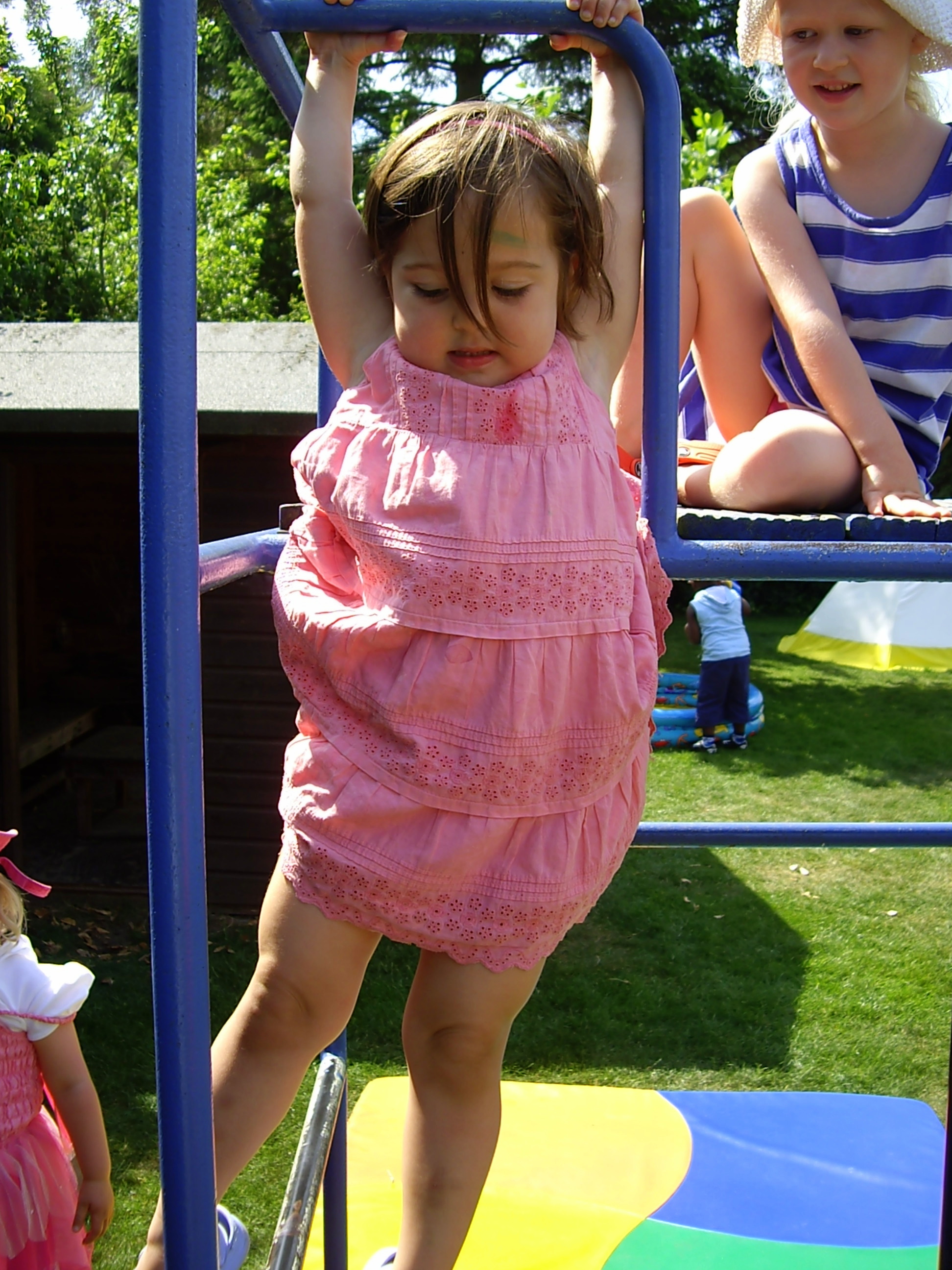
little climber

The same child, two years later and superbly fit, is now a rather more adventurous climber …..

Four years old. Hanging 6 feet off the ground and giving me nightmares about head injuries and paraplegia! How can those tiny hands hold on so tight? But nevertheless I have to admire her.
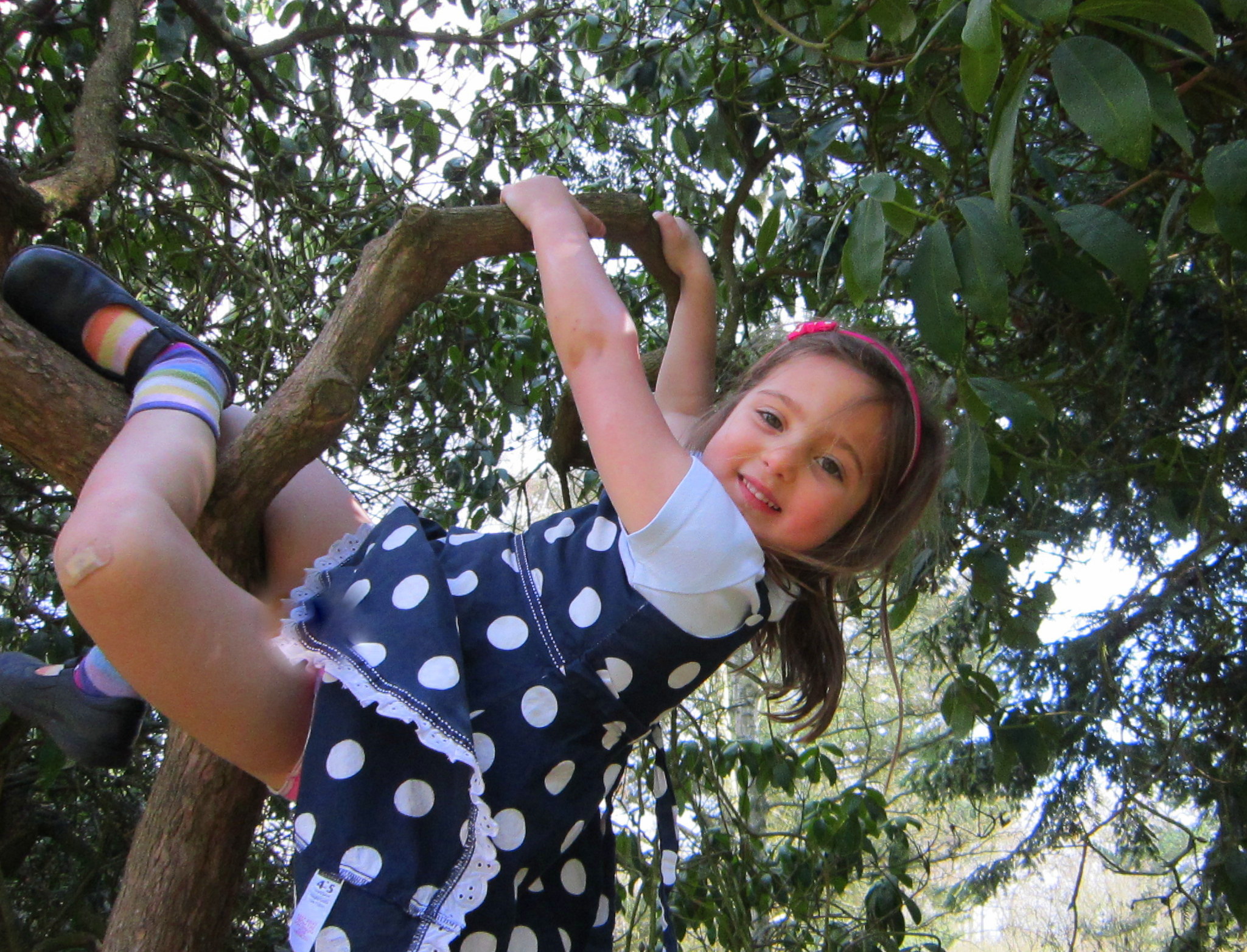
I know another two year old who takes the greatest pleasure in climbing high into the trees at every opportunity, and is as relaxed and at home up there as a little squirrel. I think she is amazing. She thinks this is totally natural, the trees are her friends and it’s the best fun in the world. But could every child be this amazing if we simply let go of our fears and let them explore? Rainforest children shin up trees like monkeys, after all. You can always stand underneath!

Note: climbing barefoot is much easier and safer.

I now tend to trust a child to follow his instincts, and try to encourage his own motivation. A child learns to trust his own judgement if you show trust in him. By surrounding a child with a richly sensory environment in which he is free to follow his own inclination to reach out and discover, he becomes a bold adventurer who desires to conquer the unknown. Moreover, he develops a strong sense of spatial awareness. Skilful mastery over his own body also develops strong self esteem, which comes naturally from achievement – not necessarily from praise.

I never, EVER say “Don’t climb, you’ll fall.” I find this makes a child anxious and more likely to fall! Instead I encourage him by saying, “If you feel safe climbing up there, then I’m sure you’ll be OK. What strong hands you have! You are a very good climber. You are holding on so tightly!” The child then trusts himself, relaxes and climbs safely and confidently.

Nobody needs to teach a child to climb. They have an inbuilt urge to climb. They LOVE a challenge. And I really think challenging their own limits does them a lot of good. They learn perseverance, gain confidence and become strong, agile and fit. It IS possible for a very young child to climb safely and easily and attempt daredevil feats that scare the **** out of us lesser mortals. Just look at children who live in the rainforest! I watch these English children every day doing a fraction of what forest dwelling children can do, and only wish I had their fearlessness and self-belief.

The Joy of Discovery

Standard

Young children have an inbuilt hunger to understand their world; they are biologically created to explore, create and seek out new experiences. They need to master their environment and grow in independence.

Cocooned in Bubble Wrap

Too much TV and safe programmed entertainment can eventually squash that desire and result in a passive, dependent, dissatisfied and frustrated child, who is easily bored and relies on adult-directed activities rather than developing their own imagination. I’ve watched it happen.

The Plastic Trap

Sometimes children just get bored with their collections of plastic toys. And no wonder – most mass-market toy manufacturers are specifically aiming to make themselves maximum profit by encouraging a ‘collect the set’ mentality rather than thinking of maximum play value for your child; after all, the more limiting the toy, or the more easily it breaks, the more toys you will have to buy! And also, to be fair, the amount of regulations attached to toy manufacture make it virtually impossible to sell anything really interesting because (unlike life) it has to be 100% SAFE! So manufacturers prefer to follow the herd, stick to what sells and make more of the same.

This makes me angry: we, and our children, are being cheated by greed and red tape! So what do we want to teach our children with the toys we give them? How can we know what is a truly worthwhile toy that will be loved, treasured and returned to again and again?

The key, from what I have observed, lies in two qualities: simplicity and discoverability. Simple objects can often stimulate a child’s imagination because he has to stretch to figure out how to play with it. What could it be? And discoverability because children are intensely curious and love investigating every new object they find.

We need to allow them the gift of discovering it themselves, instead of wading in and robbing them of that joy by telling them “This is a nutcracker. It cracks nuts like this.” To your child, it could be a space rocket.

Put these two ideas together. A collection of simple items waiting to be discovered. You have a Discovery Box.

And what’s the point of a Discovery Box? How is it different to any other toy?

Think about your child’s other toys for a minute. A doll says “nurture me, pretend I am your baby” or “this is what you are aiming to be when you’re a teenager”. A plastic dinosaur says ” make me roar and stamp”. A pirate set says “now we sail the seas and all go ‘ooaaarrr’ “. Board games have rigid rules.

A Discovery Box has no set agenda. The child takes the lead and decides what to do with it. It can be or do anything on any given day, according to your child’s imagination and investigation.

Child-directed Learning

I believe children are their own best teachers, and if we can only listen to them (their REAL needs, not the ones our materialist culture programs into them) then they will teach us what we need to know to care for them and what to provide them with. I want to counteract the bland plastic Disney-princess-collection culture that it is so easy to buy into, and instead, help enrich a child’s world and facilitate their journey of exploration through life.

Immersive Education

Shin’ichi Suzuki taught very young children to play the violin by simply immersing them in a musical environment from before birth to encourage musical ‘language’ development and sensitivity. Surrounded by adults and older children who played musical instruments for the joy of it. Once they became able to reach out and speak, they naturally wanted to learn to play music themselves. Exactly the same way in which children learn to speak, by hearing language all around them. This method of learning was later adapted to other types of education.

I aim to tap into this same kind of Suzuki attitude. Not to teach, but to facilitate a joy in natural learning, based on the child’s curiosity reaching out into an enriched environment full of exciting possibilities, rather than simply complying with our adult educational agenda.

Learning Gentleness

I like to give children real things and also let them handle delicate or breakable items, like the miniature china tea set which this little one is learning pouring with. He absolutely loved his tea set.

He got really excited on a trip into the town centre where we discovered a whole tea shop! REAL teapots and plates!!! He had to handle them all! We came home with a new set of beautiful rainbow spoons.

He loved to come shopping with me. I never told him, “Don’t touch!” as I so often hear mothers say to their children. For a start, that simply doesn’t work – children NEED to touch everything! And they see adults touching everything in the shop! I wanted him to learn how to handle china gently, and how else would he learn? He proved to me every time I took him out that he COULD be trusted to be very gentle, as he went around the shop investigating ornaments while the assistant hovered, looking jittery. 😁 I just crouched next to him saying softly and REALLY CALMLY, “We have to be Very Gentle with this. It’s Delicate.” And he was! We’ve never had a single breakage!

This is really handy in other real life situations. How many two year olds could you trust to carry a china plate loaded with snacks to a table on the far size of a hall jam packed with mothers and toddlers? This one did, without dropping so much as a grape.

But then he had the benefit of a year’s experience with his Sensory Discovery Box, investigating a multiude of objects made of heavy stone, light cork and balsa, delicate feathers and shells, robust rubber, squashy wool, hard wood, soft suede and fur, rough pumice and bark. I’m sure his Discovery Box helped him develop an awareness of the sensory properties of anything he was likely to encounter. His hands taught his brain how to handle each thing.

Had he only been allowed to play with plastic toys, I would not be remotely surprised if he broke anything else.

Update: At the age of eight, having gone through ten sensory and other discovery boxes, this same little boy is an ardently curious, focused, wildly imaginative little being who is absolutely confident in his physical abilities, is a fearless climber, has exceptional spatial awareness (he’ll do somersaults in the air) and is a leader in the playground because of his original and exciting ideas for games.

When he grows up, he wants to be an inventor.